

Vancouver Hosts: How Dynamic Pricing Lifted RevPAR 25%
Dynamic pricing strategy means adjusting your rate continuously based on demand, competitor rates, inventory, and how far out someone is booking, instead of setting one nightly price and leaving it alone for months. The primary payoff is more total revenue, not just a higher rate: Hostaway’s study found dynamic pricing users saw RevPAR climb 25.1% compared to static-rate listings. The methods, evidence, and setup steps below show exactly how that happens.
TL;DR:
Dynamic pricing can increase revenue by about 25% through ongoing rate adjustments based on demand, competition, and local events.
Rates should be recalculated daily or multiple times a day to respond effectively to market shifts, especially during high-volatility periods.
Various methods like time-based surges, competitor comparison, and value-based pricing suit different markets and require manual or automated tuning.
Proper setup involves defining clear objectives, regularly updating comp sets, setting price floors and ceilings, and monitoring booking trends weekly.
Outsourcing dynamic pricing to a managed service ensures continuous market adjustments and prevents underperformance caused by stale data or over-automation.
Table of Contents
What Dynamic Pricing Actually Tracks
Static pricing sets one number and hopes the market cooperates. Dynamic pricing does the opposite: it treats price as a variable that should move every time the underlying conditions move. Harvard Business School’s explainer frames it as a strategy that responds to market signals like supply, demand, competitor pricing, and inventory levels, rather than a fixed number pulled from a spreadsheet once a year.
For a Vancouver Airbnb owner, that means your Tuesday-in-February rate and your Friday-during-a-convention rate should never look the same. The engine (whether that’s a piece of software or a person doing the math manually) is constantly weighing a handful of inputs:
Supply and demand: how many similar listings are available versus how many guests are searching for those dates.
Competitor pricing: what comparable properties in your comp set are charging right now, not last month.
Inventory and availability: how much of your calendar is still open as a date approaches.
Lead time: bookings made 60 days out carry different pricing logic than a last-minute Thursday booking.
Day of week and seasonality: weekend premiums, summer peaks, shoulder-season dips.
Local events: conferences, concerts, and holidays that spike demand in a specific window.
Booking pace: how quickly a given date is filling relative to historical patterns for that same date last year.
Most pricing engines recalculate rates daily, sometimes multiple times a day during high-volatility periods like a major event announcement. That cadence matters more than most owners realize. A rate that updates once a week is functionally still static pricing with a slower failure mode.
Dynamic Pricing Methods and When Each One Fits
Not every method suits every business. The right choice depends on how much demand data you have, how fast your market moves, and how much risk you’re willing to tolerate on any given night.
Time-based or surge pricing. Rates rise automatically around fixed calendar events (holidays, weekends, festival weeks) and fall in slow periods. This works well when demand patterns repeat predictably year over year, which is most short-term rental markets.
Competitor-based comp-set pricing. You set your rate as a percentile against a defined group of similar listings, say the 60th percentile of a 15-property comp set. This suits markets with dense inventory and good visibility into what rivals charge.
Value-based or elasticity pricing. Price is set according to what the market will actually bear for your specific amenities and reviews, not just what neighbors charge. This needs enough historical booking data to model how demand responds to price changes, so it fits established listings better than brand-new ones.
Cost-plus, skimming, and penetration pricing. Cost-plus adds a margin to your fixed costs, useful as a floor rather than a full strategy. Skimming starts high and drops over time, common for new listings with unique positioning. Penetration starts low to build reviews and booking velocity before shifting to demand-based rates.
Bundle and length-of-stay (LOS) rules. Discounts for weekly or monthly stays, or bundled cleaning fees, that adjust the effective nightly rate without touching the headline price.
Retail businesses tend to lean on competitor-based and time-based rules because inventory turns fast. Service businesses often use value-based pricing since capacity is fixed and personalization matters more. Short-term rentals usually blend all of the above: comp-set data sets the baseline, time-based rules handle known peaks, and LOS rules protect occupancy during slow stretches.
What the Revenue Data Actually Shows
The strongest evidence for dynamic pricing isn’t theoretical. Hostaway’s difference-in-difference study compared listings using dynamic pricing against a static-rate control group and found measurable, repeatable gains.
RevPAR rose 25.1%, occupancy rose 28.6%, while average daily rate actually dropped slightly in the treatment group, according to Hostaway’s research. That combination is the whole point of the strategy: total revenue went up even though the average nightly rate went down, because more nights got booked at rates that matched what the market would actually pay on each specific date.
That’s the mechanic most owners miss. Dynamic pricing isn’t primarily about charging more. It’s about charging the right amount on the right night, which sometimes means pricing lower on a dead Tuesday to fill a room that would otherwise sit empty at zero revenue. A vacant night at a high asking rate earns nothing. A booked night at a lower rate earns something, and it also protects your listing’s search ranking, since platforms reward consistently booked calendars.
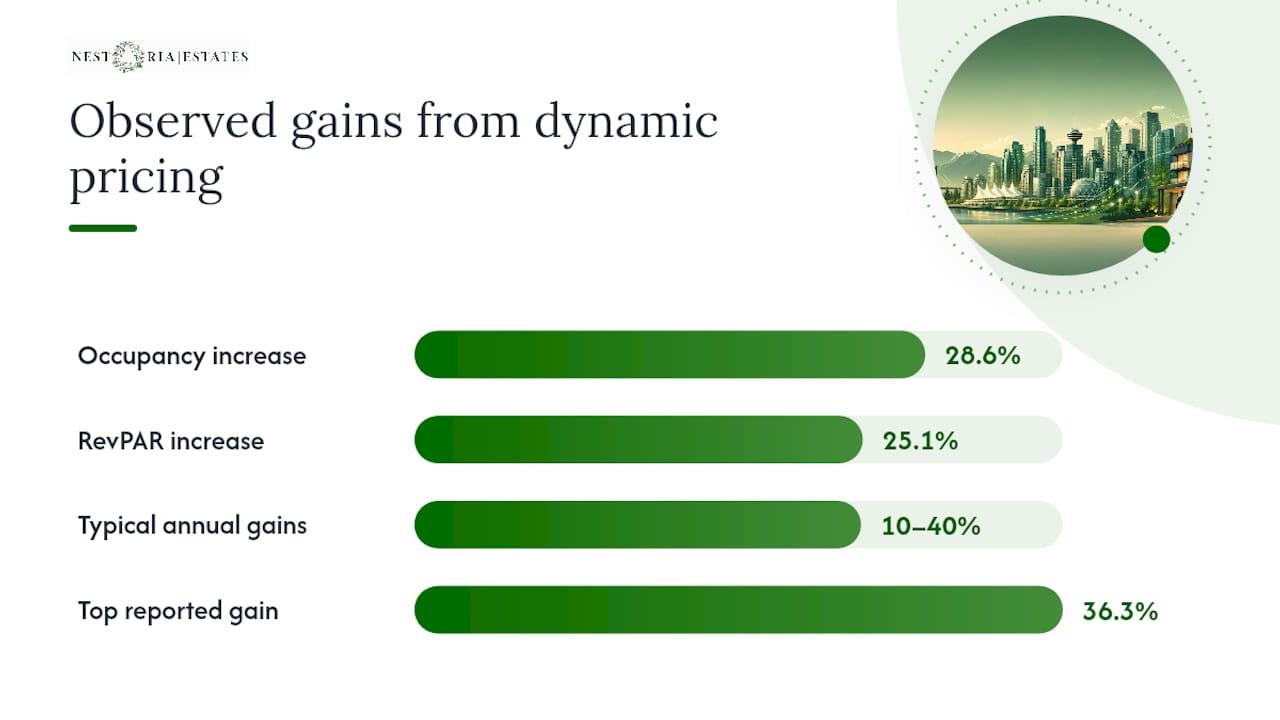
A separate 2025 industry study reported gains up to 36.3% in revenue for listings pairing dynamic pricing with a dedicated pricing provider, citing seasonality, lead time, and comp-set inputs as the main levers, per Your. Other industry analyses put typical annual gains for hosts switching from static to dynamic pricing in the 10% to 40% range, according to AirROI’s glossary research.
A few caveats worth flagging before you take these numbers as gospel:
These are difference-in-difference comparisons against control groups in specific markets, not universal guarantees for every listing type or city.
Sample composition matters. A study weighted toward urban markets with high competitor density won’t necessarily predict outcomes in a niche rural market.
“Revenue increase” figures typically measure the shift from static to dynamic pricing, not dynamic-pricing-tool-A versus dynamic-pricing-tool-B.
The pattern shows up outside short-term rentals too. Airlines have run demand-based seat pricing for decades. Ride-hailing apps raise fares during storms and event letouts. Hotels have used revenue management systems since the 1980s. Short-term rentals are simply the newest industry to formalize what airlines figured out first: price is not a fixed cost, it’s a lever.
Building Your Dynamic Pricing Playbook Step by Step
A pricing engine without a strategy behind it just automates guesswork faster. Here’s the sequence that actually produces results.
Define your objective and KPIs first. Decide whether you’re optimizing for RevPAR, occupancy, ADR, or booking conversion rate. These goals sometimes conflict, and an algorithm defaulting to “fill every night” will quietly erode your average rate if you don’t tell it otherwise.
Set your base price from comp-set median, refreshed quarterly. Pull 10 to 15 genuinely comparable listings, take the median rate, and use that as your anchor. Stale comp sets are one of the most common reasons pricing engines underperform.
Configure floors and ceilings. A floor stops the algorithm from panic-discounting during a slow stretch; a ceiling stops it from pricing you out of the market during a surge it’s over-reading. Add seasonal tiers so summer floors differ from winter floors.
Build event overrides. Local conventions, concerts, and holidays need manual rate bumps layered on top of automated rules, since most engines lag on newly announced events.
Automate the routine, reserve manual control for the exceptions. Let the system handle daily recalculation for normal demand shifts. Step in yourself for anomalies: a sudden cancellation wave, a competitor’s listing going offline, a citywide event just announced.
Integrate inventory rules with distribution. Minimum-stay requirements, LOS discounts, and channel sync across Airbnb, Vrbo, and direct booking need to move together, or you’ll create rate parity problems across platforms.
Set a monitoring cadence. Check booking pace weekly, audit your comp set monthly, and run a full strategy review quarterly. RevFactor’s revenue management guide frames this cadence as the difference between owning a pricing tool and actually running revenue management.
Pro Tip: Set your floor at a rate that still covers your fixed costs plus a minimum margin, then forget about it. The temptation to lower the floor “just this once” during a slow week is exactly how pricing strategies quietly become race-to-the-bottom discounting.
For owners who want a deeper breakdown of this cadence applied specifically to a Vancouver calendar, our step-by-step rental pricing guide walks through the same sequence with local seasonal patterns built in.
What This Looks Like for a Vancouver Host
A Vancouver property coming under managed pricing typically goes through a 60-day high-touch setup before settling into a steady cadence. That window covers a full base-rate audit against a real comp set (not just the five listings Airbnb happens to surface), a review of the property’s booking pace history, and calibration of floors and ceilings against actual operating costs.
The technology stack behind that setup usually has three layers: a property management system (PMS) to centralize bookings, a pricing engine to run the daily rate math, and channel sync to keep Airbnb, Vrbo, and any direct-booking site aligned so a guest never sees two different prices for the same date.
Owners working with a managed service like Nestoria Estates typically retain visibility through:
Free revenue projections before any pricing changes go live.
Transparent monthly owner reports showing rate history against occupancy and revenue.
Direct input on floor and ceiling settings, so the algorithm operates within limits the owner actually approves.
Escalation triggers for anomalies, meaning a human reviews the calendar when a major event or unusual booking pattern shows up, rather than letting an algorithm run unsupervised through a demand spike.
That combination matters because Hostaway’s data shows occupancy gains of 28.6% under dynamic pricing, and an unmonitored system chasing occupancy alone can undercut your rate more than necessary to hit that number. Human oversight is what keeps the RevPAR gain from getting eaten by an algorithm optimizing the wrong variable. Our Vancouver-specific pricing guide covers local seasonal patterns like ski season spillover and summer cruise traffic that a generic algorithm often misses entirely.
Where Dynamic Pricing Goes Wrong
The most common failure isn’t the algorithm. It’s the setup behind it.
Stale base prices. A comp set built six months ago in a fast-moving market is already wrong.
Wrong comp set. Comparing your two-bedroom condo against studio listings skews every recommendation downstream.
Over-automation. Letting the system run unsupervised through a major local event, a competitor exiting the market, or a sudden demand collapse.
Ignoring guest perception. Reviews and word of mouth respond badly to rates that feel arbitrary or exploitative, and customer review data in hospitality consistently shows perceived fairness affects repeat bookings and review scores.
On the legal side: dynamic pricing itself is a normal, widely used pricing method and isn’t illegal in Canada. It becomes a legal problem only when pricing crosses into price-fixing or collusion with competitors, or when it violates sector-specific consumer protection rules that apply to regulated industries. General dynamic pricing for short-term rentals doesn’t fall into either category on its own, but owners operating across multiple jurisdictions should consult legal counsel for anything touching antitrust exposure or local consumer protection statutes.
What Experienced Operators Actually Do Differently
Most hosts treat dynamic pricing as a tool to install and forget. Experienced operators treat it as revenue management with tooling attached, which means someone still owns the objective, reviews the comp set, and catches anomalies the algorithm misreads. For a Vancouver host, the highest-leverage moves are a genuine base-rate audit, real floors tied to actual costs, and a weekly pacing check that never gets skipped, no matter how well the system seems to be running on autopilot.
— Kamran
How Nestoria Estates Handles Pricing So You Don’t Have To
Nestoria Estates is the option for Vancouver owners who want the revenue lift dynamic pricing produces without becoming the person who has to babysit a comp set every week. Instead of a raw pricing tool you configure yourself, you get pricing optimization, continuous market-based rate adjustments, and monthly owner reporting handled as part of professional management.

That means a free revenue projection before you commit to anything, floor and ceiling settings you actually approve, and a team watching for the local events and demand shifts that a self-managed algorithm tends to miss until it’s too late. If you’re weighing whether to run this yourself or hand it off, the fastest way to see the difference is to request a revenue projection through our services page and compare it against what your calendar is currently earning.
Sources
FAQ
Is Dynamic Pricing Legal in Canada?
Yes, dynamic pricing is a legal, widely used pricing method in Canada. It only becomes a legal issue if it involves price-fixing with competitors or violates sector-specific consumer protection rules, so consult a lawyer for jurisdiction-specific compliance if you operate across multiple regions.
Does the .99 Pricing Trick Actually Work?
Charm pricing can nudge perceived value slightly, but it’s a minor psychological lever compared to the revenue impact of true demand-based rate adjustments like those documented in the Hostaway study.
How Can Guests Outsmart Dynamic Pricing?
Guests can reduce what they pay by booking further in advance or waiting for last-minute gaps, avoiding peak local event dates, and comparing rates across multiple platforms since parity isn’t always perfect. None of this changes how hosts should set their own strategy.
Can You Give an Example of Dynamic Pricing?
A Vancouver Airbnb raising its rate during a major convention week and lowering it during a slow February weekday is dynamic pricing in action. Ride-hailing apps charging more during a storm and airlines raising fares as a flight fills up follow the same logic across other industries.
What’s the Difference Between Dynamic Pricing Software and Revenue Management?
Dynamic pricing software executes rate changes automatically based on preset rules and market data. Revenue management is the strategic layer above it, where a person defines the objective, sets inventory rules, and reviews performance, as RevFactor’s guide explains.
Recommended
Comments