

Monetizing Premium Rentals: Your 2026 Vancouver Guide
- info67421305
- 4 days ago
- 8 min read

The most effective way to monetize a premium vacation rental in Vancouver right now combines dynamic pricing, luxury brand positioning, and airtight regulatory compliance. Owners who treat these three as separate tasks leave money on the table. The ones pulling top revenue treat them as a single system.
Here are the core levers that drive income for premium rentals in 2026:
Dynamic pricing adjusted in real time for demand signals, local events, and seasonal shifts
Minimum stay policies calibrated by season to protect your nightly rate
Luxury marketing across targeted digital channels with professional photography
Premium amenities and guest services that justify higher rates and earn repeat bookings
Ancillary revenue through upsells like early check-in, concierge add-ons, and curated experiences
Regulatory compliance with Vancouver’s licensing requirements baked into your pricing model
Technology and automation via platforms like Hostfully and Rentals United for operational efficiency
Tools like Hostfully and Rentals United help owners manage listings across channels while keeping pricing consistent. Nestoriaestates, headquartered in Vancouver, takes this further by combining data-driven pricing with full operational management so owners stay hands-off while revenue stays high.
Pro Tip: Plan your seasonal pricing 3–6 months ahead. Owners who set rates early capture shoulder season bookings from business travelers and remote workers before competitors fill those dates.

What are the key revenue levers for premium vacation rentals?
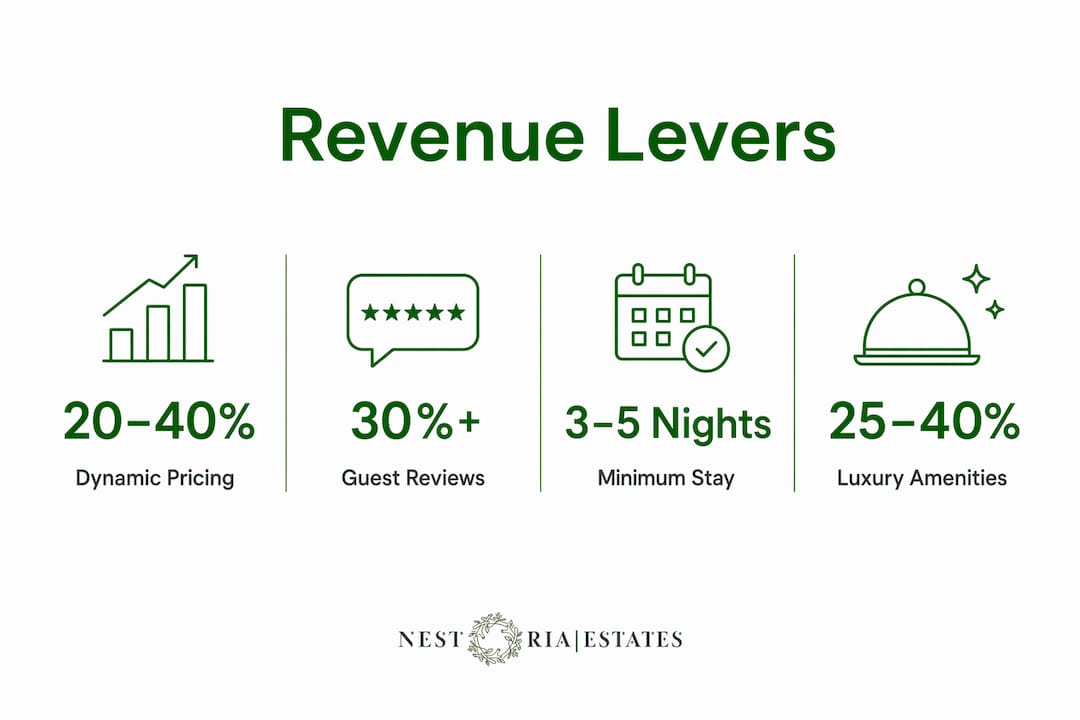
Pricing is the single highest-impact lever, and most owners underuse it. Dynamic pricing tools can increase annual revenue by 20–40% compared to static rates by reading competitor pricing, booking pace, and local event demand in real time. The goal is not maximum occupancy. Revenue per available night (RevPAN) is the metric that actually matters. A property at 75% occupancy charging $160 per night outperforms one at 95% occupancy at $100 per night.

Minimum stay requirements work alongside pricing. Setting a 3–5 night minimum during peak season filters out low-value short bookings that drive up cleaning and operational costs without proportional revenue. Off-peak, drop the minimum to fill gaps.
Direct bookings are an underused revenue channel. Because OTAs charge host fees, a direct booking strategy with a best-rate guarantee can reduce fees by up to 15% per booking while offering guests a lower price. That margin goes straight to your bottom line.
Key revenue levers at a glance:
Base rate calibration: Set within 10–15% of comparable properties in your Vancouver neighborhood
Dynamic pricing tool: Automates rate adjustments above your base; apply manual overrides for events
Hard price floor: Never price below your true nightly cost including fees, cleaning, and maintenance
Minimum stay policy: 3–5 nights at peak, flexible off-peak
Direct booking channel: Best-rate guarantee to reduce OTA commission drag
Upsells: Early check-in, late checkout, grocery pre-stocking, local experience packages
Guest screening: Qualify guests upfront to protect the property and reduce costly damage incidents
Guest reviews increase booking likelihood by over 30% for luxury rentals. A strong reputation is not a soft metric. It directly affects how often your listing converts at your target rate. Nestoriaestates builds review management into its full-service model, tracking guest feedback and responding systematically to protect listing performance.
Pricing Lever | Revenue Impact |
Dynamic pricing vs. static | 20–40% annual revenue increase |
3–5 night peak minimum stay | Reduces low-value bookings, protects nightly rate |
Direct booking (vs. OTA) | Up to 15% fee savings per booking |
Strong review profile | 30%+ increase in booking likelihood |
How do you market a luxury vacation rental in Canada?
Luxury marketing starts with positioning, not promotion. Your listing needs to communicate a specific experience, not just a list of features. A Vancouver waterfront property with a private deck and concierge service is not competing on price. It is competing on experience. Every photo, headline, and description should reflect that.
Professional photography is non-negotiable at the premium tier. Guests comparing a $400-per-night rental against a hotel expect visual quality that matches the price. Listings with high-quality images and curated descriptions consistently outperform those with phone photos, regardless of the underlying property quality.
Platforms like Hostfully and Rentals United extend your reach across multiple booking channels while keeping your rates and availability synchronized. This matters because premium guests often research across several platforms before booking. Inconsistent pricing or availability gaps erode trust before the conversation even starts.
Key marketing actions for luxury rentals:
Aspirational listing copy: Lead with the experience, not the bedroom count
Professional photography: Wide-angle interiors, exterior shots, and lifestyle images
Multi-channel distribution: Hostfully and Rentals United for consistent cross-platform presence
Targeted digital ads: Focus on high-income traveler segments on Instagram and Google
Repeat guest program: Offer returning guests a direct booking discount to bypass OTA fees
Referral incentives: Encourage past guests to refer friends with a small booking credit
Pro Tip: Align your marketing pushes with your pricing calendar. Launching a social campaign for peak summer dates in February, when shoulder season inventory is still open, captures early planners before your competitors have even updated their listings.
For owners looking at resort markets beyond Vancouver, seasonal pricing strategies used in high-demand coastal destinations offer useful benchmarks for structuring your own peak and shoulder rate tiers.
What amenities justify premium pricing for luxury rentals?
Luxury rentals with high-end amenities like private pools and concierge services command 25–40% higher rates than comparable properties without them. That premium is not automatic. Guests have to perceive the value before they book, which means presentation matters as much as the amenity itself.
Cleanliness and maintenance are the baseline. A property with a private hot tub that arrives with a watermark ring loses the premium immediately. Guests at this price point have stayed in five-star hotels. Their tolerance for operational sloppiness is zero, and their willingness to leave a public review about it is high.
Curated experiences add perceived value without large capital investment. A welcome basket with local Vancouver products, a printed guide to neighborhood restaurants, or a pre-arranged kayak rental partnership costs relatively little but signals genuine hospitality. These touches also generate the kind of specific, enthusiastic reviews that convert future guests.
Premium amenities and services that support higher pricing:
Private pool, hot tub, or sauna
Concierge service or dedicated property contact
High-end kitchen appliances and espresso equipment
Smart home features (keyless entry, automated lighting, premium sound system)
High-speed internet suitable for remote work
Curated local experience packages (dining reservations, activity bookings)
Hotel-quality linens and toiletries
Regular deep cleaning with documented maintenance records
Upsell opportunities layer onto these amenities naturally. Early check-in, late checkout, grocery pre-stocking, and airport transfer arrangements are all services premium guests expect to pay for when offered clearly. Build these into your guest communication flow rather than waiting for guests to ask.
How should you plan seasonal pricing for maximum income?
Planning seasonal rates 3–6 months ahead is the single most consistent differentiator between top-performing Vancouver hosts and average ones. Reactive pricing, adjusting rates the week before a peak period, means the best-positioned competitors have already filled their calendars at full rate.
Vancouver’s peak Airbnb season runs june through august, with the softest stretch in january and february. According to recent market analysis, the average Vancouver short-term rental earned about $32,387 per year in 2025-2026 with an occupancy rate of 54.8% and nightly rate of $215. Top-performing properties in the top 10% command nightly rates above $444 and monthly revenues above $8,405. The gap between median and top-tier performance is almost entirely explained by pricing strategy and listing quality, not location alone.
Dynamic pricing algorithms are a starting point, not a complete solution. Manual overrides for local events like conferences, festivals, and long weekends consistently outperform algorithm-only pricing because no tool has perfect local intelligence. Build a Vancouver event calendar and review it monthly.
Key figure: Vancouver’s top 10% of short-term rental listings earn $8,405 or more per month, compared to a market median of $3,335, according to AirROI’s 2026 data.
Seasonal pricing framework for Vancouver premium rentals:
Peak (june–august): Set rates 25–40% above base; apply 3–5 night minimums; open calendar 6–8 months out
Shoulder (may, september): Set rates 5–15% above base; target business travelers and remote workers; accept last-minute bookings at full rate
Off-peak (january–february): Price at or near base; reduce minimum stay requirements; consider extended-stay discounts for remote workers
Regulatory costs belong in your pricing model from day one. Vancouver requires an annual short-term rental licence costing $1,108 plus a $77 application fee, and your licence number must appear on every listing. B.C.'s provincial registry, mandatory as of may 2025, adds another compliance layer. A listing suspended for a clerical error during peak season is revenue lost permanently. Nestoriaestates manages this compliance layer as part of its full-service management offering, so owners do not carry that operational risk alone.
Pro Tip: Integrate a local Vancouver event calendar directly with your pricing tool. Major events like the Vancouver International Film Festival or Celebration of Light create demand spikes that algorithms often undervalue. A manual rate override for those specific dates can add meaningfully to your seasonal total.

Nestoriaestates handles pricing optimization, guest communication, cleaning coordination, and owner reporting for Vancouver Airbnb owners who want professional rental management without the daily operational load. If you want a free revenue projection for your property, Nestoriaestates provides one at no cost before you commit to anything.
Key Takeaways
Premium rental income in Vancouver depends on combining dynamic pricing, luxury positioning, and regulatory compliance into one coordinated system rather than managing each in isolation.
Point | Details |
Dynamic pricing drives revenue | Hosts using dynamic pricing tools earn 20–40% more annually than those using static rates. |
RevPAR beats occupancy as a metric | A property at 75% occupancy and $160/night outperforms one at 95% occupancy and $100/night. |
Amenities command real premiums | Luxury rentals with private pools and concierge services earn 25–40% higher rates than comparable properties. |
Seasonal planning must be early | Setting rates 3–6 months ahead captures shoulder season bookings before competitors fill those dates. |
Compliance protects revenue | Vancouver’s $1,108 annual licence fee and provincial registration must be built into pricing from the start. |
FAQ
What does a typical Vancouver Airbnb earn per year?
In 2025-2026, the average Vancouver short-term rental earned about $32,387 per year, with an occupancy rate of 54.8% and nightly rate of $215. Top-performing properties in the top 10% earn $8,405 or more per month.
How much does a Vancouver short-term rental licence cost?
The City of Vancouver charges a $1,108 annual licence fee plus a $77 non-refundable application fee. Your licence number must appear on every online listing and be posted physically inside the rental unit.
What is RevPAR and why does it matter more than occupancy?
RevPAR (Revenue Per Available Night) multiplies your nightly rate by your occupancy rate, giving a single number that reflects both how often you book and at what price. Optimizing for RevPAR rather than occupancy alone consistently produces higher net income.
When should I start planning seasonal pricing for my Vancouver rental?
Set your peak, shoulder, and off-peak rates 3–6 months before each season begins. Owners who price reactively, adjusting rates the week before peak demand, lose bookings to competitors who opened their calendars early at full rate.
Do I need to register with the B.C. provincial registry as well as get a Vancouver licence?
Yes. As of may 1, 2025, all short-term rental hosts operating in B.C. must register with the provincial short-term rental registry in addition to holding a City of Vancouver business licence. Both registration numbers must appear on your listings.
Recommended
Comments