

How Reviews Drive Rental Success for Vancouver Hosts
- info67421305
- Jul 9
- 8 min read

TL;DR:
Guest reviews are the most influential ranking factor in the short-term rental market in 2026. Maintaining high recency, volume, and quality of reviews directly improves search visibility, bookings, and income. Operational excellence in cleaning, accuracy, and check-in is essential to achieve positive, recent reviews and Guest Favorites status.
Guest reviews are the single most powerful ranking signal in the short-term rental market, directly controlling your listing’s visibility, booking rate, and long-term income. In 2026, reviews account for approximately 25% of Airbnb’s search ranking weight through the Guest Favorites badge. That number makes the role of reviews in rental success impossible to ignore. Vancouver hosts compete in one of Canada’s most saturated short-term rental markets, where a fraction of a star separates a fully booked calendar from a listing that sits idle. Understanding how guest feedback shapes your ranking, your reputation, and your revenue is the first step to changing your results.
How do guest reviews influence rental search rankings and visibility?
Reviews are not just social proof. They are a direct input into Airbnb’s ranking algorithm, and their weight has grown significantly in 2026. The Guest Favorites badge requires hosts to maintain a 4.9 or higher average across six specific subcategories: cleanliness, accuracy, check-in, communication, location, and value. Missing even one of those subcategory thresholds disqualifies a listing from the badge, regardless of how strong the overall star rating looks.
The algorithm does not treat all reviews equally. Recent reviews carry more weight than older ones, which means a strong review history from two years ago offers diminishing protection today. A Vancouver host who earned 50 glowing reviews in 2023 but has slowed bookings since then will rank lower than a newer listing with 15 recent five-star reviews. Recency signals activity, reliability, and current quality.
High review volume combined with consistently positive ratings compounds the ranking benefit. More reviews give the algorithm more data to work with, which increases its confidence in your listing’s quality score. That confidence translates directly into higher placement in search results.
Guest Favorites badge requires a 4.9+ average across all six subcategories
Recent reviews outweigh older ones in the ranking calculation
Volume plus quality produces stronger ranking signals than quality alone
Subcategory scores are evaluated individually, not just as an average
Pro Tip: Check your subcategory scores in your host dashboard at least once a month. A single weak subcategory, even if your overall rating looks fine, can suppress your search placement without any obvious warning sign.
What operational strategies help hosts earn consistent positive reviews?
The path to high rankings is operational, not promotional. Hosts who focus on the physical and logistical quality of each stay consistently outperform those who rely on charm or discounts alone. Three areas produce the most measurable impact on review scores: cleaning standards, listing accuracy, and check-in experience.

Professional cleaning with photo verification is now a baseline requirement in competitive markets like Vancouver. A missed cleaning detail can drop a cleanliness subcategory score from a 5 to a 3 in a single review. That kind of drop is hard to recover from quickly, especially given how much weight recent reviews carry. Hosts who use professional cleaners with a documented checklist and photographic sign-off before each guest arrives protect themselves from this risk. Nestoriaestates coordinates exactly this kind of professional cleaning standard for Vancouver properties.
Listing accuracy is equally critical. Guests who arrive and find a property that does not match its photos or description leave low accuracy scores, and those scores drag the overall rating down. Every photo should reflect the current state of the property. Every amenity listed must be available and functional.
Self-check-in with smart locks and detailed instructions consistently outperforms traditional key handoffs in check-in ratings. Guests value flexibility and certainty. Knowing they can arrive at 11 PM without coordinating with a host removes friction and creates a positive first impression that carries into the review.
Professional cleaning with photo sign-off protects cleanliness scores between stays
Accurate listings prevent accuracy score drops from mismatched expectations
Smart lock check-in with clear instructions improves check-in ratings and guest confidence
Consistent operational checklists reduce the chance of a single bad stay damaging your average
Pro Tip: Update your listing photos every six months. Seasonal changes, new furniture, or even different lighting can make older photos misleading, which guests notice and rate accordingly.
Which review subcategories most affect your rental performance?
Airbnb’s AI evaluates each subcategory score individually. A weak score in any single category can lower your search rank even when your overall star rating looks strong. Vancouver hosts need to know which categories are most sensitive and what operational changes fix them.
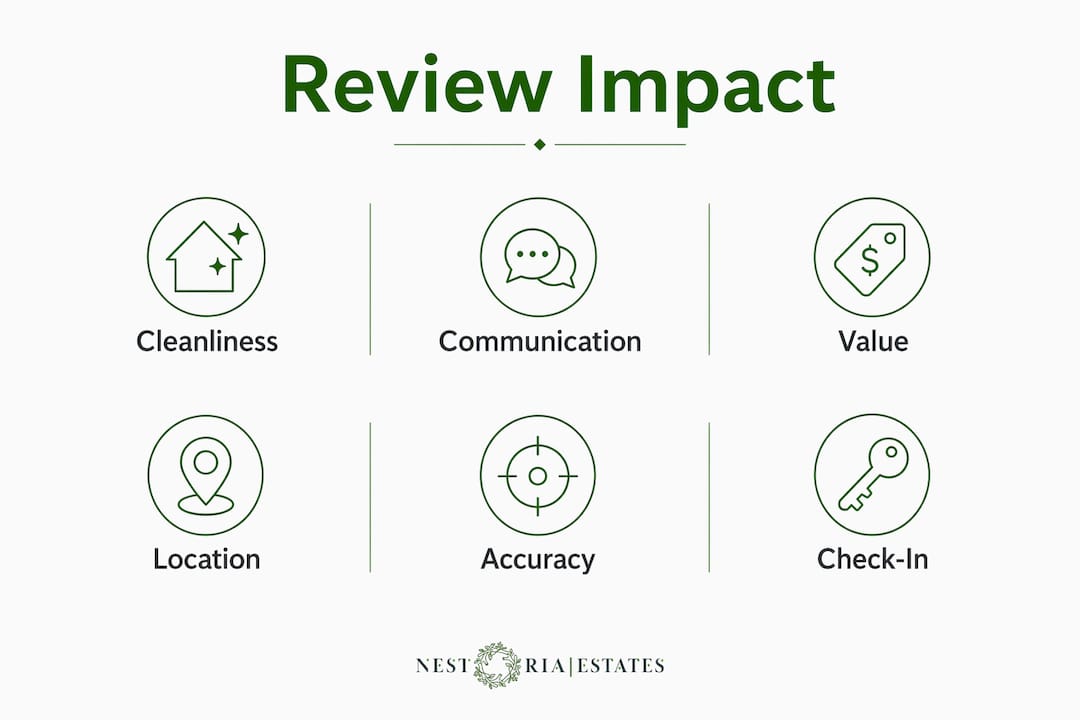
Cleanliness is the most binary category in the system. Guests either feel the space is clean or they do not. There is very little middle ground in how people rate it. A single hair on a pillow or a sticky stovetop can produce a 3-star cleanliness rating from an otherwise satisfied guest. This makes cleanliness the highest-risk subcategory and the one that rewards professional management most directly.
Value ratings depend on how your pricing compares to similar listings in your area. Pricing more than 20% above market without a clear justification pulls value scores down, even when guests enjoy their stay. Vancouver’s rental market is price-sensitive, and guests who feel they overpaid will say so in the value subcategory. Competitive pricing aligned with market rates is a direct input into your review average.
Subcategory | Primary risk factor | Operational fix |
Cleanliness | Missed cleaning details | Professional cleaning with photo verification |
Accuracy | Misleading photos or descriptions | Regular listing audits and photo updates |
Check-in | Coordination delays or unclear instructions | Smart lock with step-by-step guest instructions |
Communication | Slow or unclear host responses | Automated messaging with personal follow-up |
Value | Pricing above comparable market listings | Dynamic pricing aligned to local market data |
Location | Misrepresented proximity to amenities | Accurate, specific location descriptions |
Communication and location subcategories are harder to control but still matter. Communication scores reflect response speed and clarity. Location scores reflect whether your listing description honestly represents what guests will experience. Both reward accuracy and transparency over marketing spin.
How can property owners use reviews to increase bookings?
Positive guest reviews reduce booking hesitation. A guest browsing Vancouver listings will choose a property with 80 detailed five-star reviews over one with 10 reviews of the same rating, because volume signals consistency. Conversion rate from views to bookings is now the top ranking factor in Airbnb’s algorithm, and reviews are a primary driver of that conversion.
Hosts who actively respond to reviews build visible credibility. A thoughtful response to a critical review shows future guests that the host takes feedback seriously and acts on it. That behavior builds trust in a way that a perfect rating alone cannot. Responding to positive reviews reinforces the relationship with past guests and signals attentiveness to new ones.
Displaying guest feedback in your listing description, where platform rules allow, adds social proof at the point of decision. Specific quotes about what guests loved, such as the view, the kitchen, or the neighborhood, help future guests picture their own stay. That specificity converts browsers into bookers.
High review volume signals consistency and reduces booking hesitation
Responding to reviews builds host credibility and demonstrates accountability
Specific guest praise in listing descriptions adds targeted social proof
Hosts who request feedback post-checkout see improved review volume and ranking
What role do review recency and volume play over time?
Maintaining a steady flow of recent reviews matters more than accumulating a large archive of old ones. The algorithm depreciates older reviews over time, which means a host must keep generating new bookings and new feedback to sustain ranking position. This is not a one-time achievement. It is an ongoing operational discipline.
Keep minimum stay requirements competitive. Overly long minimum stays reduce booking frequency and slow the pace of new reviews. Shorter minimums in slower seasons keep the review pipeline active.
Send a post-checkout message within 24 hours. A brief, personal message thanking guests and inviting them to share their experience produces measurably higher review rates than no follow-up at all.
Use dynamic pricing to maintain occupancy during low-demand periods. Empty nights produce no reviews. Pricing adjustments that fill gaps in the calendar keep the review cadence consistent.
Monitor your review pace monthly. If new reviews slow down, it is a signal to examine pricing, minimum stays, or listing visibility before the ranking impact becomes visible.
Consistent positive reviews across all categories build the credibility required for Guest Favorites status, which supports higher occupancy and stronger pricing power over time. The compounding effect of a well-managed review profile is one of the most durable advantages a Vancouver host can build.
Key Takeaways
Guest reviews directly control search ranking, booking conversion, and long-term rental income, making review management the most important operational priority for Vancouver Airbnb hosts in 2026.
Point | Details |
Reviews drive ranking weight | Guest Favorites status accounts for approximately 25% of Airbnb’s search ranking in 2026. |
Recency beats volume alone | Recent reviews carry more algorithm weight than older ones, requiring consistent booking activity. |
Subcategory scores matter individually | A weak cleanliness or value score can suppress ranking even when the overall star rating is high. |
Operational quality is the fix | Professional cleaning, accurate listings, and smart check-in directly improve subcategory scores. |
Review volume builds conversion | Higher review counts reduce booking hesitation and improve the views-to-bookings conversion rate. |
What Vancouver’s review competition actually looks like
Vancouver is not a forgiving market for hosts who treat reviews as an afterthought. I have seen properties with genuinely beautiful spaces sit at 60% occupancy while a smaller, plainer unit nearby runs at 90%, simply because the smaller unit has 120 recent reviews and a Guest Favorites badge. The badge is not decoration. It is a ranking mechanism that puts certain listings in front of more guests every single day.
What surprises most owners I work with is how much cleanliness drives everything else. Guests who feel a space is spotless tend to rate everything higher, including value and location, even when those factors are unchanged. A clean space creates a psychological halo that lifts the entire review. That is why I believe professional cleaning is the single highest-return investment a Vancouver host can make, not because it is glamorous, but because the data in subcategory scores proves it every time.
The other thing I would push back on is the idea that chasing the Superhost badge is the primary goal. Guest Favorites now carries more ranking weight than Superhost status in 2026. Superhost is still worth having, but it is a byproduct of doing the operational work correctly, not a strategy in itself. Focus on the six subcategories, keep your reviews recent, and the badges follow.
— Kamran
How Nestoriaestates helps Vancouver hosts build stronger review profiles
Property owners who want better reviews without managing every operational detail themselves have a clear path forward with Nestoriaestates.

Nestoriaestates handles the full operational stack that drives review quality: professional cleaning with photo verification before every stay, listing accuracy audits, dynamic pricing aligned to Vancouver’s market, and guest communication from booking confirmation through post-checkout follow-up. Every one of those touchpoints maps directly to a review subcategory. Owners who work with Nestoriaestates see the impact in their subcategory scores, their Guest Favorites eligibility, and their occupancy rates. Learn more about the full range of property management services Nestoriaestates offers Vancouver hosts.
FAQ
How much do reviews affect Airbnb search ranking?
Reviews account for approximately 25% of Airbnb’s search ranking weight in 2026 through the Guest Favorites badge. That makes them one of the most influential factors in listing visibility.
What rating do I need to earn the Guest Favorites badge?
Hosts need a 4.9 or higher average across all six subcategories: cleanliness, accuracy, check-in, communication, location, and value. A weak score in any single subcategory disqualifies the listing from the badge.
Do older reviews still help my ranking?
Older reviews depreciate in algorithm weight over time. Recent reviews carry significantly more ranking influence, which is why maintaining consistent bookings and post-checkout review requests is critical.
Which review subcategory is hardest to recover from?
Cleanliness is the most sensitive subcategory. A single missed cleaning detail can drop the score from 5 to 3, and because recent reviews carry the most weight, recovery requires several subsequent perfect stays.
How can I get more guests to leave reviews?
Sending a personal post-checkout message within 24 hours of a guest’s departure produces higher review rates than no follow-up. Hosts who actively request feedback after stays see improved review volume and stronger ranking outcomes.
Recommended
Comments