

The Role of Property Listing Services in Rental Success
- info67421305
- Jun 9
- 8 min read

TL;DR:
Property listing services amplify property visibility by syndicating data across multiple platforms and optimizing listing details. They significantly increase inquiries, shorten sales cycles, and raise final sale prices when listings are complete and professionally presented. Owners should treat listings as active marketing assets, leveraging professional visuals and strategic management to maximize income potential.
Property listing services are platforms and systems that centralize, distribute, and market real estate data to connect property owners with qualified buyers and renters across multiple channels simultaneously. For Vancouver Airbnb owners and real estate investors, understanding the role of property listing services is the difference between a property that sits idle and one that generates consistent, predictable income. These services operate across two primary layers: the Multiple Listing Service (MLS), which is the industry’s structured data backbone, and consumer-facing portals like Zillow, Realtor.com, and Airbnb, which translate that data into bookings and inquiries. Getting both layers right is where most owners either win or leave money on the table.
What is the role of property listing services?
Property listing services function as the distribution infrastructure for real estate marketing. When a property is listed, its data moves through a chain: from the owner or agent to the MLS, then out to syndicated portals, and finally in front of prospective guests or buyers. Each step in that chain either amplifies or dilutes your property’s visibility.

The MLS is the foundation of this system. Homeowners cannot submit directly to the MLS and must work through a licensed member agent. This requirement exists because the MLS is a cooperative database built on professional accountability, not a public marketplace. From there, MLS data feeds power automated valuations like Zillow’s Zestimate, comparative market analyses (CMAs), and appraisals. That means your listing data does not just attract inquiries. It also shapes how your property is priced and valued over time.
For short-term rental owners in Vancouver, the importance of property listings extends beyond the MLS. Platforms like Airbnb, Vrbo, and Google Vacation Rentals each have their own algorithms that reward completeness, quality visuals, and early engagement. Understanding how these systems rank and surface listings is the first step toward controlling your property’s income potential.
How syndication multiplies your reach
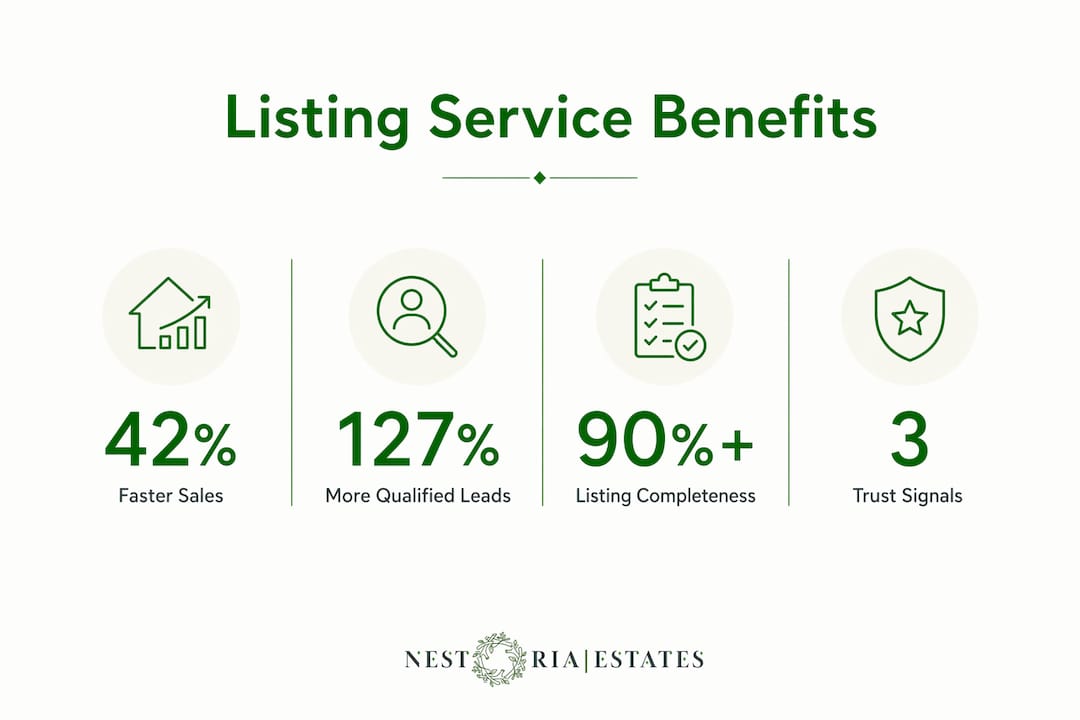
Syndication is the automated process by which a single listing entry gets distributed to dozens of consumer portals at once. A listing entered into the MLS can appear on Zillow, Redfin, Realtor.com, and hundreds of regional sites within hours. Listings promoted across 4+ platforms generate 127% more qualified inquiries than MLS-only exposure. That figure reflects a straightforward reality: more distribution points mean more eyes, and more eyes mean more competitive offers or booking requests.
Pro Tip: When entering your listing into any platform, treat every data field as a ranking signal. Incomplete fields do not just look unprofessional. They reduce your listing’s appearance in filtered searches.
What are the real benefits of using listing services?
The measurable benefits of property listing sites go well beyond basic exposure. Optimized listings sell 42% faster, generate 3.2x more qualified inquiries, and achieve 6 to 9% higher final sale prices compared to non-optimized entries. For a Vancouver property valued at $800,000, a 6% price improvement represents $48,000 in additional return. That is not a marginal gain. It is a direct result of treating your listing as a marketing asset rather than a data entry task.
Listing completeness is one of the most underrated levers available to owners. Listings with 90%+ field completion receive 41% more showing requests. Every skipped field is a missed filter match. When a prospective guest or buyer searches for a two-bedroom property with parking and a washer/dryer, your listing only appears if those fields are filled in accurately.
Trust signals also play a measurable role in conversion. Verified photos, inspection reports, and clear fee disclosures reduce buyer and renter churn and increase premium placement on portals. Guests who encounter ambiguous pricing or unverified photos abandon listings at a significantly higher rate. Transparency is not just ethical. It is a conversion strategy.
The MLS also serves a pricing function that owners often overlook. Real estate agents use MLS data for comparative market analyses, and appraisers rely on it to establish property value. If your listing data is inaccurate or incomplete, it can distort your property’s perceived market value in ways that affect future financing, refinancing, or sale negotiations.
How do listing service options compare?
Not every property owner needs the same level of service. The market offers three primary tiers, each with distinct cost structures and owner responsibilities.
Service type | Cost | Owner responsibilities | Best for |
Full-service agent | 2 to 3% commission | Minimal. Agent handles pricing, marketing, showings, and negotiations | Owners who want hands-off management |
Limited-service agent | $500 to $1,500 | Owner handles showings and some negotiations | Owners with some real estate experience |
Flat-fee MLS | $300 to $1,000 | Owner manages showings, negotiations, and closing | Experienced investors comfortable with transactions |
Full-service agents handle the entire sales or rental process at a 2 to 3% commission. This model suits Vancouver Airbnb owners who want professional representation without dedicating personal time to the transaction. Limited-service agents offer partial support, typically covering listing input and basic consultation, while leaving showings and negotiations to the owner.
Flat-fee MLS services provide listing syndication to portals at a one-time cost of $300 to $1,000, but they require owners to manage showings and negotiations independently. This option attracts cost-conscious investors, but it carries a critical risk that many overlook. Flat-fee MLS clients frequently misunderstand broker obligations, assuming the arrangement is entirely self-managed when brokers still carry baseline professional responsibilities. Owners using this model should require explicit written statements defining the broker’s scope of work before signing anything.
The right choice depends on your time availability, transaction experience, and income goals. For short-term rental owners focused on maximizing Airbnb revenue in Vancouver, the full-service or managed approach typically delivers better returns because professional marketing and pricing expertise more than offset the commission cost.
Best practices for optimizing your listing visibility
Listing optimization is not a one-time task. It is an ongoing process that directly affects how algorithms rank your property and how quickly prospective guests convert from browsers to bookers.
Use professional photography as your baseline. The first 10 seconds of a viewer’s attention hinges on photos and precise data. Smartphone photos taken in poor lighting are not a substitute for professional images. Budget for a real estate photographer who understands composition and natural light.
Add 3D virtual tours. Listings with 3D virtual tours receive 49% more engagement than photo-only listings. For Vancouver properties targeting international Airbnb guests who cannot visit in person, a virtual tour is a direct booking conversion tool.
Consider AI virtual staging. AI virtual staging costs 91% less than physical staging and increases showing requests by 3x. For vacant investment properties, this technology removes a major visual barrier without the logistics of furniture rental.
Complete every data field. MLS listing input should be treated as the first marketing campaign, where every field improves searchability and professionalism. Accurate pricing is especially critical. Mispricing can hide listings from key search filters entirely.
Monitor and refresh early engagement. Early listing activity such as views, saves, and shares in the first 48 to 72 hours impacts future listing visibility in platform algorithms. If a listing stalls in the first week, updating photos, adjusting pricing, or refreshing the description can restore algorithmic momentum.
Pro Tip: For Airbnb-specific listings, use data-driven optimization tools that analyze local demand signals and competitor pricing. Reacting to market shifts in real time keeps your listing competitive during peak and off-peak seasons in Vancouver.
You can explore more on rental listing optimization to see how professional presentation translates directly into higher Airbnb income.
Key takeaways
Property listing services generate maximum rental income only when listings are treated as active marketing assets, not passive database entries.
Point | Details |
Syndication multiplies reach | Listings on 4+ platforms generate 127% more qualified inquiries than single-platform exposure. |
Completeness drives conversions | Listings with 90%+ field completion receive 41% more showing requests from prospective guests. |
Visual quality determines first impressions | 3D tours and professional photos increase engagement by 49% and triple showing request rates. |
Service tier affects control and cost | Full-service agents cost 2 to 3% commission; flat-fee MLS costs $300 to $1,000 but requires owner management. |
Early engagement shapes long-term visibility | Algorithm performance in the first 48 to 72 hours determines how often a listing surfaces in future searches. |
What most owners get wrong about listing services
I have worked with enough Vancouver property owners to recognize a pattern. Most treat their listing as a form to fill out, not a sales page to craft. They upload whatever photos are on their phone, skip the virtual tour because it feels like an extra step, and wonder why their Airbnb calendar has gaps in February and March.
The uncomfortable truth is that listing input is critical marketing. Every field you complete, every photo you upgrade, and every trust signal you add is a direct input into how algorithms rank you and how guests perceive your property in the first 18 seconds of their search. That 18-second window is not a metaphor. It is the average time a prospective buyer or renter spends evaluating a listing before deciding to engage or scroll past.
What I find most owners underestimate is the compounding effect of early engagement. A listing that gets strong views and saves in its first 72 hours gets surfaced more frequently by the platform’s algorithm going forward. A listing that launches quietly tends to stay quiet. This means your launch strategy matters as much as your listing content. Coordinating a price, photos, and description refresh simultaneously, rather than making changes piecemeal, creates a stronger signal to the algorithm that the listing is active and worth promoting.
The other thing I tell owners consistently: do not confuse a flat-fee MLS entry with a complete marketing strategy. Getting your property into the MLS is the starting point, not the finish line. The owners who maximize income are the ones who treat their listing like a product launch, with professional visuals, complete data, and active management from day one.
— Kamran
How Nestoriaestates helps Vancouver owners maximize listing performance

Nestoriaestates works with Vancouver Airbnb owners who want professional listing management without the operational overhead. The team handles everything from professional photography coordination and listing creation to pricing optimization and guest communication, so your property performs at its peak across every platform.
If you are a property owner in Vancouver looking to close the gap between your current rental income and what your property could actually earn, the Nestoriaestates services page outlines exactly how the team approaches listing optimization, market-based pricing, and full-cycle short-term rental management. You can also explore what a property listing service for rentals actually includes before deciding on your next step. For a direct conversation about your property’s potential, reach out to the team for a free revenue projection.
FAQ
What does a property listing service actually do?
A property listing service centralizes your property’s data and distributes it across the MLS and consumer portals like Zillow, Airbnb, and Realtor.com to generate qualified inquiries. It also provides the pricing data infrastructure used for appraisals and comparative market analyses.
Why use property listing services instead of listing directly?
Homeowners cannot submit directly to the MLS without a licensed agent, and professional listing services provide syndication, marketing expertise, and trust signals that significantly increase inquiry volume and conversion rates.
How do property listing service features affect Airbnb bookings?
Features like complete data fields, professional photos, 3D virtual tours, and verified trust signals directly influence how Airbnb’s algorithm ranks your listing and how quickly prospective guests decide to book.
What is the difference between flat-fee MLS and full-service listing?
Flat-fee MLS costs $300 to $1,000 and places your listing in the database, but you manage showings and negotiations yourself. Full-service agents charge 2 to 3% commission and handle the entire process, typically delivering better outcomes for owners without transaction experience.
How quickly does listing optimization affect visibility?
Early listing engagement in the first 48 to 72 hours directly impacts how often a platform’s algorithm surfaces your listing in future searches, making a strong launch strategy critical to long-term visibility.
Recommended


Comments