
The Role of Hospitality in Vacation Rentals: 2026 Guide
TL;DR:
Hospitality in vacation rentals focuses on personalized care, operational reliability, and technology to create memorable stays. It emphasizes cleanliness, accurate descriptions, fast communication, and local insights to improve reviews and encourage repeat bookings. Proper use of automation and diligent operational practices help hosts deliver consistent, high-quality guest experiences.
Hospitality in vacation rentals is defined as the practice of blending personalized guest care, operational reliability, and technology to create memorable stays that drive repeat bookings and higher revenue. The role of hospitality in vacation rentals goes far beyond clean sheets and a welcome note. 81% of travelers read reviews before booking, and 79% choose higher-rated properties over lower-rated ones. That data makes one thing clear: hospitality quality is a direct booking driver, not a soft extra. For Vancouver property owners managing short-term rentals, understanding this shift from real estate thinking to travel industry thinking is the foundation of competitive success.
What is the role of hospitality in vacation rentals?
Hospitality in the vacation rental context means treating every guest stay as a curated travel experience, not a property transaction. Hotels have operated on this principle for decades. Vacation rental owners are now held to the same standard, and the market data confirms it.

The industry term for this shift is guest experience management, which covers every touchpoint from the first booking inquiry to the post-stay review. It includes communication speed, property condition, local knowledge sharing, and the personal warmth that turns a one-time guest into a repeat visitor. Property owners who treat guest experience management as a core business function consistently outperform those who treat it as an afterthought.
Vancouver’s short-term rental market is particularly competitive. Guests arriving in the city have access to hundreds of listings across every price point. The properties that win are not always the most expensive or the most elaborately furnished. They are the ones where the host communicates clearly, the property is exactly as described, and the guest feels genuinely looked after.
What are the essential hospitality principles vacation rental owners must adopt?
The fundamentals of guest satisfaction are well documented, and the data is unambiguous about where owners should focus first.
Cleanliness is the single biggest factor in negative reviews. Cleanliness appears in 81% of negative reviews as the primary complaint. That number means a spotless property is not a differentiator. It is the baseline. Owners who invest in consistent turnover cleaning with sign-off inspections see measurable improvements in their review scores.
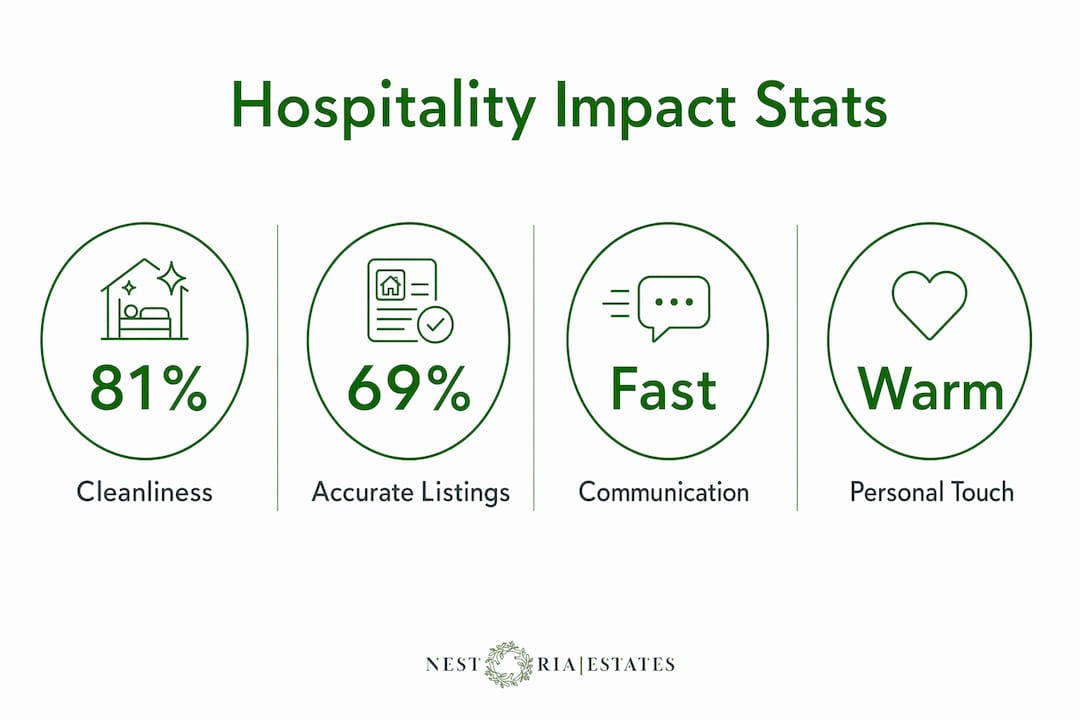
Accurate listing descriptions prevent disappointment before it starts. Inaccurate listings drive dissatisfaction in 69% of negative review cases. A guest who arrives expecting a mountain view and finds a parking lot wall does not leave a five-star review, regardless of how clean the property is. Every photo and description must reflect the actual space.
Responsive communication is a binary success factor. Guests who wait hours for answers book elsewhere or leave frustrated reviews. Response times under 60 seconds dramatically improve guest sentiment. This is not about being available around the clock personally. It is about having a system that responds immediately.
Personal warmth drives loyalty beyond any amenity. Personal connection and friendliness are the top predictors of repeat bookings. A handwritten note, a local restaurant recommendation, or a check-in message that uses the guest’s name costs nothing and creates a lasting impression.
Pro Tip: Build a pre-arrival message template that includes the guest’s first name, two local restaurant recommendations near your property, and a direct contact number for urgent issues. This single touchpoint addresses cleanliness anxiety, sets expectations, and establishes personal warmth before the guest even arrives.
How does technology enhance hospitality without replacing the human touch?
Tech-enhanced hospitality is the recognized industry standard for modern vacation rental management. It uses automation to remove friction while preserving the personal warmth that drives loyalty. The goal is not to replace human interaction. It is to make human interaction more consistent and more available.
Here is how the best-performing properties apply this model:
Keyless entry systems remove the single most stressful moment of any stay: the check-in. Smart locks allow guests to arrive on their own schedule without coordinating key handoffs. This is especially valuable for late-night arrivals in Vancouver, where guests may be traveling across time zones.
AI-powered messaging platforms handle routine inquiries instantly. Questions about parking, Wi-Fi passwords, and checkout times do not require a human response. Automated check-in systems can reach 93% completion rates and reduce guest complaints significantly. That frees up the host’s attention for the interactions that actually matter.
Digital guidebooks replace the paper binder that guests never read. A well-built digital guide covers appliance instructions, neighborhood recommendations, emergency contacts, and house rules in a format guests can access from their phone before they even land.
Automated review requests sent within an hour of checkout capture guest sentiment while the experience is still fresh. Properties that request reviews systematically receive more of them, which compounds over time into a stronger booking position.
Pro Tip: Never automate the message that handles a complaint or a problem. When something goes wrong, a real person responding within minutes does more for your review score than any amenity upgrade ever could.
The risk of over-automation is real. Guests notice when every message sounds like a template. The fix is simple: use automation for logistics and use humans for anything emotional. A well-designed booking workflow maps exactly which touchpoints need a personal response and which ones can run on autopilot.
What operational practices align property management with hospitality excellence?
The shift from real estate management to travel industry hospitality changes what property management actually means. Real estate management focuses on asset preservation. Hospitality management focuses on stay experience. Both matter, but the priority order is different.
Maintenance as a guest experience function
Preventive maintenance is not just about protecting the property. It is about making sure nothing breaks during a guest’s stay. A leaking faucet reported on a Friday night is a hospitality failure, not just a plumbing issue. Systematic preventive maintenance with clear escalation paths prevents small issues from becoming disruptive guest problems. Properties with documented maintenance schedules receive fewer mid-stay complaints and higher overall ratings.
Turnover cleaning with quality control
Cleaning between stays is not a housekeeping task. It is a quality control process. The best-performing properties use a sign-off inspection after every clean, with a checklist that covers every room. This catches the missed item under the bed or the soap dispenser that was not refilled. Consistent turnover protocols are the single highest-return operational investment a property owner can make.
Pricing aligned with travel demand
Management approach | Focus | Guest experience impact |
Real estate model | Occupancy and cost control | Reactive, inconsistent |
Hospitality model | Stay quality and demand timing | Proactive, consistent |
Dynamic pricing based on Vancouver travel demand patterns keeps occupancy high without undervaluing the property. Calendar management that accounts for local events, peak seasons, and shoulder periods maximizes revenue while keeping the guest mix manageable.
Set minimum stay requirements during peak periods to reduce turnover frequency and maintain quality.
Block calendar dates for scheduled deep cleans and maintenance checks at least once per quarter.
Review pricing weekly against local market rates, not just at the start of each season.
How does hospitality create local discovery opportunities for Vancouver guests?
Vancouver guests are a distinct consumer segment. They arrive with an appetite for local experiences that a hotel lobby cannot provide. This is one of the clearest competitive advantages a vacation rental has over traditional accommodation.
Vacation rental guests spend approximately 34 cents of every guest dollar at local restaurants and services. That economic pattern reflects a guest who wants to live like a local, not just sleep in a new city. Property owners who lean into this preference create a hospitality experience that no hotel can replicate.
The practical application is straightforward:
Curate a neighborhood guide that covers your three favorite restaurants, the best coffee shop within walking distance, and one experience that tourists rarely find on their own.
Build relationships with local tour operators or activity providers and offer guests a direct contact or a small discount. This costs nothing and adds genuine value.
Mention specific Vancouver neighborhoods, markets, or seasonal events in your welcome message. A guest visiting in july who learns about the Granville Island Public Market from their host remembers that detail.
Hosts who position themselves as local guides rather than property managers build guest loyalty that shows up directly in reviews. Guests describe the host, not just the property. That distinction matters enormously in a market where every listing looks similar in photos.
Pro Tip: Update your local recommendations seasonally. A summer guide that mentions a farmers market that runs only in june through september tells guests you are paying attention. Stale recommendations signal the opposite.
Key takeaways
Hospitality in vacation rentals requires cleanliness, fast communication, personal warmth, and technology working together to produce reviews that drive bookings and revenue.
Point | Details |
Cleanliness is non-negotiable | 81% of negative reviews cite cleanliness, making it the highest-return operational investment. |
Response speed determines satisfaction | Replies under 60 seconds dramatically improve guest sentiment and review scores. |
Tech supports, humans connect | Automate logistics like check-in and FAQs; keep human responses for complaints and personal moments. |
Local knowledge differentiates listings | Guests spend 34 cents per dollar locally, and hosts who guide that spending earn stronger loyalty. |
Operational basics beat amenity upgrades | Reliable maintenance, accurate listings, and consistent cleaning outperform expensive renovations in review impact. |
Why I think most vacation rental owners are investing in the wrong things
The most common mistake I see Vancouver property owners make is spending money on the wrong problems. A new espresso machine or a smart TV upgrade gets attention during a listing photo shoot. It does not get mentioned in reviews. What gets mentioned is whether the host responded quickly when the Wi-Fi went down, whether the property was exactly as described, and whether the guest felt like someone actually cared about their stay.
The amenity arms race is a real trap. Owners see a competitor add a hot tub and feel pressure to match it. The data does not support that instinct. Operational reliability, communication speed, and cleanliness deliver the highest return on every dollar spent. A guest who had a flawless, responsive, clean stay will book again and recommend the property. A guest who stayed in a beautifully furnished property where the host took four hours to respond to a question will not.
The other thing I would push back on is the idea that automation and hospitality are in tension. They are not. The guest experience guide for 2026 makes this clear: guests want fast answers and genuine care. Those two things are not mutually exclusive. You can automate the answer to “what is the Wi-Fi password” and still write a personal message when a guest mentions it is their anniversary. The owners who figure out that balance are the ones who consistently earn five-star reviews in a market as competitive as Vancouver.
— Kamran
How Nestoriaestates helps Vancouver owners build hospitality-driven rentals
Running a vacation rental at a hospitality standard is a full-time operation. Cleaning coordination, guest communication, maintenance scheduling, and pricing management each require consistent attention that most property owners cannot sustain alongside other commitments.
Nestoriaestates manages every one of those functions for Vancouver property owners. The team handles turnover cleaning with quality control inspections, responds to guests around the clock, coordinates preventive maintenance, and adjusts pricing based on live market data. Owners receive transparent reporting and revenue projections without managing a single guest message. If you want your property to perform at a hospitality standard without running it yourself, explore Nestoriaestates’ services to see exactly what full-service management covers.
FAQ
What does hospitality mean in vacation rental management?
Hospitality in vacation rental management means treating every guest stay as a curated travel experience. It covers communication speed, property cleanliness, accurate listings, personal warmth, and local knowledge sharing.
Why do reviews matter so much for vacation rental success?
81% of travelers read reviews before booking, and 79% choose higher-rated properties. Review quality is a direct driver of booking volume and nightly rate.
How fast should a vacation rental host respond to guest messages?
Response times under 60 seconds produce the highest guest satisfaction scores. AI-powered messaging platforms make this achievable without requiring the owner to be personally available at all hours.
Is technology a threat to personal hospitality in vacation rentals?
Technology supports hospitality when used correctly. Automating logistics like check-in and routine questions frees hosts to focus on personal interactions that actually build guest loyalty.
What is the single highest-return investment for a vacation rental owner?
Consistent turnover cleaning with sign-off inspections delivers the highest return in review improvement. Cleanliness appears in 81% of negative reviews, making it the most direct lever for improving guest satisfaction scores.
Recommended
Comments