

The Role of Trust in Vacation Rentals: 2026 Guide
- info67421305
- Jul 3
- 8 min read
TL;DR:
Trust in vacation rentals depends on both emotional comfort and rational safety signals. Both types of trust must be present for guests to confidently book, with visible safety features and verified reviews playing crucial roles. Building reciprocal trust involves clear communication, documentation, and prompt responses from both hosts and guests.
Trust is the foundation of every successful vacation rental experience, determining whether travelers feel safe, comfortable, and confident enough to book and enjoy a stay. The role of trust in vacation rentals goes far beyond a five-star rating. It operates on two distinct psychological pathways: affective trust, which covers emotional comfort, and cognitive trust, which covers rational safety assessment. Both must be satisfied before a traveler commits to a booking. Understanding how these pathways work gives you a real advantage, whether you are planning a trip or managing a property in Vancouver.
What are the two types of trust in vacation rentals?
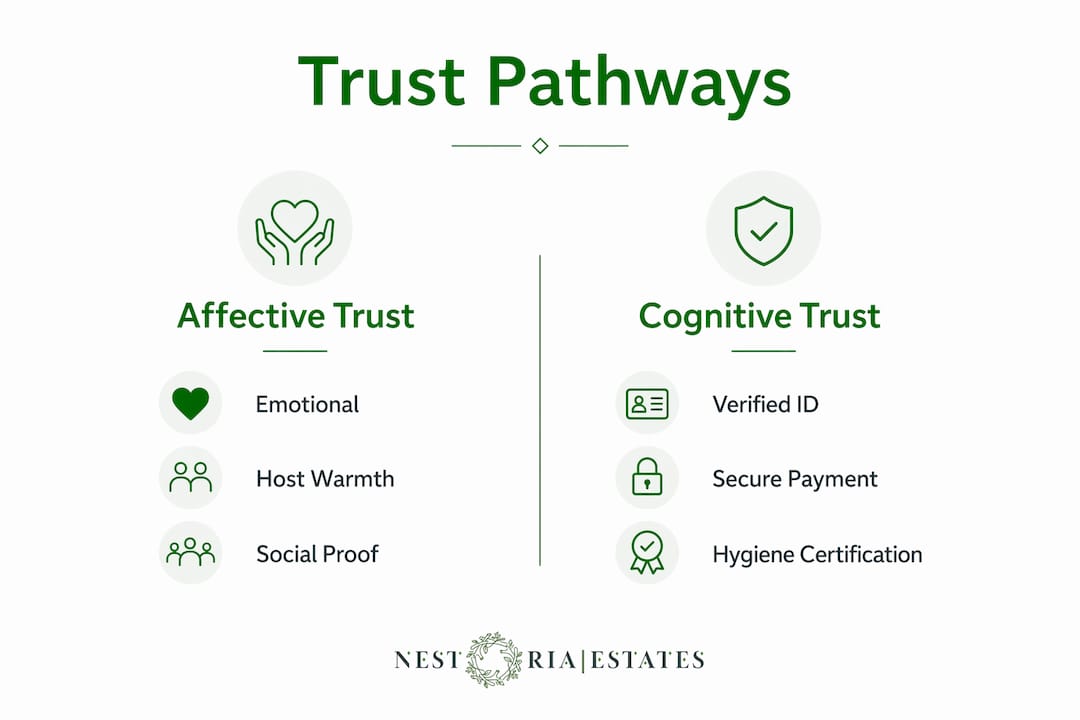
Trust in short-term rentals operates through a dual-pathway mechanism. Affective trust is the emotional side. It is the gut feeling you get when a host’s profile photo looks genuine, the listing description sounds warm and personal, and previous guests describe feeling welcomed. Cognitive trust is the rational side. It is the logical confidence you build when you see verified payment systems, documented safety features, and recent, detailed reviews.
Both types must be present for a booking decision to feel right. A beautifully photographed property with no verifiable safety information will satisfy affective trust but leave cognitive trust unmet. That gap is exactly where hesitation and abandoned bookings happen.
Affective trust: the emotional signals that matter
Affective trust builds through social proof and personal connection. A host who responds warmly within hours, shares a genuine bio, and posts photos that match the listing description creates emotional confidence. Guest reviews that describe specific personal interactions, like a host leaving local restaurant recommendations or checking in after arrival, reinforce this feeling. For travelers comparing options, hospitality and guest experience signals are often what tip the decision.

Cognitive trust: the rational signals that matter
Cognitive trust requires evidence, not just warmth. Verified identity, secure payment channels, hygiene certifications, and visible safety features all contribute. A traveler who can see a cleaning record, confirm a fire extinguisher is present, and pay through a protected platform feels rationally secure. Cognitive trust is harder to fake and harder to lose once established.
How do safety and hygiene practices build trust in rentals?
Safety failures are far more common in vacation rentals than most travelers realize. Only 42% of rental venues have fire extinguishers, despite 1.3 million U.S. fires occurring annually and causing 2,500 deaths each year. That statistic means the majority of short-term rentals leave guests exposed to a basic, preventable risk. For travelers, this is not a minor detail. It is a direct measure of how seriously a host takes their responsibility.
Hygiene failures show up just as frequently. Research confirms that 87% of negative rental experiences involved sanitation failures, and 100% included host attitude or behavioral issues. These numbers reveal that cleanliness and communication are not optional extras. They are the baseline for trustworthiness in vacation homes.
What hygiene and safety signals build the most trust?
Research shows that hygiene assurance certification is the strongest predictor of institutional trust, with a standardized coefficient of β=0.692. That means visible cleaning records and certifications carry more weight in booking decisions than almost any other single factor. Host responsiveness also correlates directly with cognitive trust, and both factors influence booking decisions at a statistically significant level.
Safety or hygiene element | Trust impact |
Hygiene certification or visible cleaning log | Highest predictor of institutional trust |
Fire extinguisher and smoke detector confirmation | Directly addresses cognitive safety concerns |
Prompt host response to pre-arrival questions | Builds cognitive trust through demonstrated reliability |
Documented emergency contacts and protocols | Reduces perceived risk before arrival |
Recent cleaning records shared pre-check-in | Signals transparency and operational consistency |
Pro Tip: Before booking, ask the host directly whether the property has a current cleaning record and confirmed fire safety equipment. A trustworthy host will answer immediately and specifically.
Hosts who want to understand why cleaning standards matter at this level will find that guests treat visible hygiene practices as a direct measure of overall property care.
What role does secure payment play in building trust with rental hosts?
Payment security is the single most critical trust factor for travelers. 72.7% of travelers identify payment security as their top concern, followed by user endorsements and trust seals at 48.5%. That gap between first and second place is significant. It tells you that travelers worry about losing money before they worry about almost anything else.
The most common scam targeting this concern is the off-platform payment request. A fraudulent host builds rapport through normal messaging, then asks you to pay via Zelle, wire transfer, or a third-party link outside the booking platform. The moment you leave the platform’s payment system, you lose all fraud protection. There is no recourse once the money is gone.
How to verify a host and protect your payment
Use this checklist before sending any money or confirming a booking:
Stay on-platform. Never pay through Zelle, wire transfer, or any link sent outside the booking platform’s official checkout.
Check identity verification. Look for hosts with verified email, phone number, and linked social media profiles. More verification layers mean more accountability.
Run a reverse-image search. Reverse-image search of listing photos catches duplicate images used across multiple fake listings. If the same photo appears under different property names, the listing is fraudulent.
Read recent reviews first. High star ratings alone are not enough. Reviews from the past 6–12 months reveal whether a property is consistently maintained. Generic five-star reviews with no specific details are a red flag for review stuffing.
Look for trust seals. Platform badges confirming identity verification and Superhost status add a secondary layer of rational confidence.
Pro Tip: If a host insists on off-platform communication or payment “to save on fees,” treat it as a scam signal regardless of how professional the listing looks.
Travelers weighing the trust factors between hotels and vacation rentals will find that payment protection is one area where hotels hold a structural advantage. Knowing this helps you demand the same standard from rental hosts.
How can travelers and hosts build reciprocal trust?
Trust in vacation rentals is not one-directional. Hosts need to trust that guests will respect the property. Guests need to trust that hosts will deliver what was promised. Reciprocal trust requires verified, consistent information and prompt communication from both sides. When either party goes silent or vague, friction builds fast and trust erodes.
Documented transparency is the most reliable tool for building this mutual confidence. Hosts who provide accessible property manuals, clear house rules, emergency contact lists, and maintenance logs visible before arrival give guests everything they need to feel secure. Guests who communicate their arrival time, ask questions upfront, and follow house rules signal reliability to the host.
What hosts can do to strengthen reciprocal trust
Publish clear house rules before booking confirmation, not buried in a post-booking message.
Provide an emergency contact separate from the booking platform, in case of connectivity issues on arrival.
Share a property manual covering appliances, Wi-Fi, parking, and local emergency services.
Respond within two hours to pre-arrival questions. Slow responses signal disorganization and reduce cognitive trust.
Log and share maintenance records for major appliances and safety equipment. Guests who see a recent HVAC service date feel more confident about the property’s overall condition.
Pro Tip: A guest-ready property checklist shared with guests before arrival does more for trust than any amount of marketing copy in the listing description.
For Vancouver Airbnb owners, the booking workflow and communication process is where reciprocal trust either gets built or broken. Guests who receive clear, timely communication from the moment they inquire are far more likely to leave positive reviews and return.
Key Takeaways
Trust in vacation rentals requires both emotional comfort and rational safety assurance, and neither pathway alone is enough to secure a confident booking decision.
Point | Details |
Dual trust pathways | Affective and cognitive trust must both be satisfied before travelers commit to a booking. |
Safety gaps are widespread | Only 42% of rentals have fire extinguishers, making visible safety features a direct trust signal. |
Payment security tops all concerns | 72.7% of travelers rank payment security as their most critical trust factor. |
Recent reviews beat star ratings | Reviews from the past 6–12 months reveal operational consistency better than overall scores. |
Reciprocal transparency wins | Hosts who share manuals, emergency contacts, and maintenance logs build lasting guest confidence. |
Why trust is the one thing you cannot fake in rentals
I have worked with enough Vancouver Airbnb owners to know that most trust problems are not caused by bad intentions. They are caused by gaps in documentation and communication that hosts never thought to close. A host who genuinely cares about their guests but fails to post a fire extinguisher location or respond within a day to a pre-arrival question will still lose bookings to a competitor who does those things consistently.
The uncomfortable truth is that trust is built through systems, not personality. A warm host with no cleaning record loses to a less personable host with a visible hygiene certification every time. Travelers in 2026 are more informed and more skeptical than ever. They run reverse-image searches. They read the negative reviews first. They check when the last review was posted. If your property cannot pass those checks, no amount of great photography will compensate.
The practical advice I give Vancouver owners is this: treat every trust signal as a public commitment. Post your cleaning schedule. Confirm your safety equipment in the listing. Respond to every inquiry within two hours. These are not extras. They are the baseline that separates properties that fill their calendars from those that do not.
— Kamran
How Nestoriaestates supports Vancouver hosts in building guest trust
Building and maintaining guest trust takes consistent effort across cleaning, communication, safety compliance, and documentation. For Vancouver Airbnb owners managing this alongside daily life, the operational load adds up fast.

Nestoriaestates handles the full operational picture for short-term rental owners, from coordinating professional cleaning and maintaining safety compliance to managing guest communication and transparent owner reporting. Every service is designed to make your property the kind of listing that passes every trust check a traveler runs. If you want to see what that looks like for your property, explore Nestoriaestates’ property management services and request a free revenue projection.
FAQ
What is the role of trust in vacation rentals?
Trust is the foundation that determines whether travelers feel safe enough to book and enjoy a stay. It operates through two pathways: affective trust (emotional comfort) and cognitive trust (rational safety assurance), and both must be satisfied for a booking decision to happen.
Why is payment security the top trust concern for travelers?
72.7% of travelers rank payment security as their most critical trust factor because off-platform payment scams are the most common fraud tactic in vacation rentals. Staying within the booking platform’s payment system is the best protection against losing money with no recourse.
How do hygiene certifications affect guest trust in short-term rentals?
Hygiene assurance certification is the strongest single predictor of institutional trust, with a standardized coefficient of β=0.692. Guests who see visible cleaning records and certifications are significantly more likely to complete a booking.
How can travelers verify a vacation rental listing is legitimate?
Run a reverse-image search on listing photos to check for duplicates across multiple listings, which signals fraud. Also read reviews from the past 6–12 months and confirm the host has verified identity on the platform.
What does reciprocal trust mean in vacation rentals?
Reciprocal trust means both the host and the guest commit to transparency and reliability. Hosts build it through documented house rules, emergency contacts, and prompt communication. Guests build it by following those rules and communicating arrival details clearly.
Recommended
Comments